Sample CDs/CD-ROMs recording Ethnic Samples, Drum & Bass Loops, Breakbeats,Multisamples. Sound Libraries for Sound Designers.
 |
       |
 |
|
|
|

|
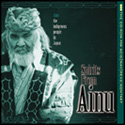
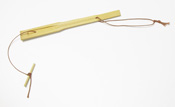
This disc contains 325 files in .wav format, suitable for Acid/Ableton Live use, as well as 318 of those files in REX2 format and 3 Kontakt programs. The Mukkuri samples are laid out as a number of variations of a one-measure in 4/4 meter pattern, well suited to Acid/Ableton Live style looping, along with one-shot samples, a number of triple-meter samples, and a series of one-measure patterns and one-shots in a higher tonality (although all of the Mukkuri samples are non-pitched). These Mukkuri performances are quite limited if used as solo material, but their worth multiplies when used as the basis for the rhythmic fundamental of a world-music track.
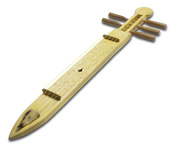
The first set of Tonkori loops are presented in a number of gentle performance in the keys of F, E and D, always relying heavily on the fundamental, fifth, sixth and ninth, and a number of arpeggios in the key of G minor and E minor. The second set contains some lovely motifs in a more ambiguous D major key, followed by E major and Eb major, and a beautiful set of harmonic samples. The third set contains more major key flourishes in E major, F major, G major, C major, Eb major and finally Gb major, followed by a set of lines in D minor. The last bank of Tonkori performances consists of rolled chords in a number of major and minor tonalities. What is most striking about these Tonkori samples is how well they blend with the Mukkuri samples - something that I found somewhat surprising, as the solo Mukkuri samples can be rather off-putting, particularly to my very Western-oriented ears, but the potential for timbre combinations becomes clear when they are paired with their soul-mated Tonkori samples. The final bank in the Spirits From Ainu disk consists of seven vocal songs ranging in length from seven seconds to two and a half minutes. These songs appear to be traditional songs passed down through many generations of Ainu culture, although the lack of documentation in the CD-ROM materials forces me to speculate on this matter. Although these songs are hauntingly beautiful in and of themselves, it must be said that without the full knowledge of their origin and a reasonable translation of the lyrical text I am hesitant to utilize them in my own tracks, particularly if the tracks are to be used as part of a film score. I can only hope that future editions of Discovery's Spirits from Ainu library will contain more information about these songs, along with a translation of the lyrics, alleviating my own trepidation about using these otherwise very intriguing vocal samples. The Ainu Instruments
Bits of Information about AINU
Umeko Ando (1932 - 2004)
An Ainu (Native Japanese) singer who passed away in 2004. Hearing her mother's mukkuri and songs, she developed her skills and came to be called "The master player of mukkuri." She had continued to respect the Ainu traditions and daily customes, and has made much effort to promote and let Ainu culture prevail by transmitting and preserving the Ainu language, traditional dancing and manners. She worked as one of the few trainers of the Ainu culture, and also cooperated in many investigations and cultural recordings. In 1983, she received the Makubetsu Cultural Promotion Award. In 1995, Makubets-cho Board of Education produced a CD "Umeko Ando - the World of Mukkuri." She also received Cultural Award from the Tokachi Council of Cultural Organizations. AINU The Ainu are an ethnic group indigenous to Hokkaido, the northern part of Honshu in Northern Japan, the Kuril Islands, much of Sakhalin, and the southernmost third of the Kamchatka peninsula. The word "ainu" means "human" in the Ainu language. The origins of the Ainu are uncertain. Some commentators believe that they derive from an ancient photo-Asian stock that may have occupied most of Asia before the Han expansion. Various other Asian indigenous peoples, from the Ryukyus to the Taiwanese are also thought to be related to them. There are most likely over 150,000 Ainu today, however the exact figure is not known as many Ainu hide their parents having kept it from them so as to protect their children from racism. |
|||||||||||||||||||||||||||||||||||||



![Sample CD/CD-ROM[I LOVE TIBET]](http://www.discoverysound.com/image/jp/title/dfsd700-2.jpg)
![Sample CD/CD-ROM[8BIT FAMILY II]](http://www.discoverysound.com/image/jp/title/8bit2-2.jpg)
![Sample CD/CD-ROM[INDONESIA - The Magic]](http://www.discoverysound.com/image/jp/title/dfsd680b.jpg)
![Sample CD/CD-ROM[DISCOVERY JAPAN]](http://www.discoverysound.com/image/jp/title/b0000002.jpg)
![Sample CD/CD-ROM[SHAMISEN]](http://www.discoverysound.com/image/jp/title/b0000106.jpg)